Redding · Anderson · Shasta Lake, CA · Updated September 2026
Tree Removal in Redding, CA — When, How, and What It Costs
As of September 2026, removing a tree in Redding, CA costs $150–$3,000+ depending on height and access, averaging about $700; a fully built single-family lot inside city limits usually needs no City permit, and a dead, split, or leaning tree within a tree-length of your house is the clearest case for removal rather than trimming.
Sundial Tree Care · (530) 555-0142 · Free quotes from independent Redding-area tree removal providers.
Remove it or trim it? The Redding version of the question
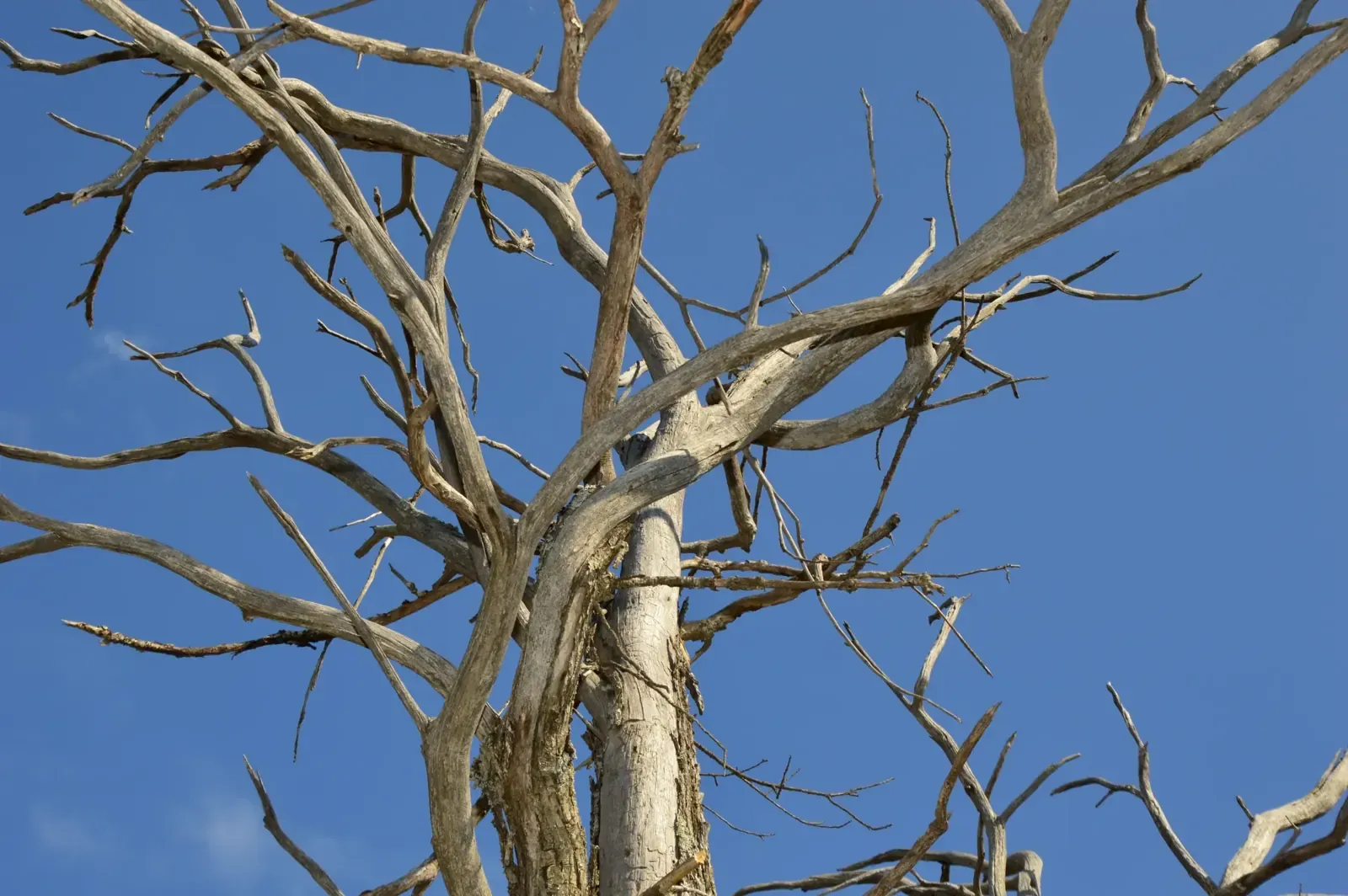
Most calls we see start with the same worry: a tree that's been fine for twenty years suddenly looks wrong. In Redding that's usually one of three stories. A blue oak or valley oak that lost a big limb in a winter storm and now has a wound the size of a dinner plate. A ponderosa or gray pine that went brown from the top down over one summer — bark beetles finish what drought stress starts, and once a pine is more than a third brown it doesn't come back. Or a fast-growing ornamental — a silver maple, a fruitless mulberry, a cottonwood by the creek — that outgrew its spot and now leans over the roof.
The rule of thumb arborists use: if the problem is structural — trunk, major union, roots — the tree comes down. If the problem is in the branches and the structure is sound, it gets pruned. The five-minute walk-around below sorts most cases; the ones it doesn't are exactly what an ISA Certified Arborist's site visit is for.
The 5-minute walk-around
Look at the base. Mushrooms, shelf fungus, soft or hollow wood, sawdust piles, or soil heaving on one side all point to root or trunk decay.
Look at the trunk. Vertical cracks, a split where two trunks meet, missing bark, or oozing. Any crack you can fit a finger into is a structural failure in progress.
Look at the canopy. Estimate how much is dead. Over a third dead, or dead on one whole side, is a removal conversation. A few dead limbs is a pruning conversation.
Check the lean. A lean the tree has always had is usually fine; a new lean, especially with cracked soil on the opposite side, is an emergency.
Measure the fall zone. Pace out the tree's height along the ground. Anything inside that circle — house, driveway, fence, neighbor's property, power line — is what the removal has to protect.
A tree that fails two or more of these — say, fungus at the base and a new lean — and stands within its own height of a house, driveway, or power line is the situation our emergency page covers. Don't schedule that one for next month.
What a Redding tree removal actually involves
Knowing the sequence helps you read a quote. A typical residential removal runs like this:
Site visit and quote. Every Redding company in our comparison advertises a free on-site estimate. The estimator is sizing the tree, the fall zone, and the access route for the chipper truck — the three things that set the price.
Utility check. If any limb is within about ten feet of a service drop or a primary line, the crew will want the utility to clear or de-energize it first. Inside city limits that's Redding Electric Utility; outside, PG&E. A tree crew that says it will "just be careful" around a live line is a red flag.
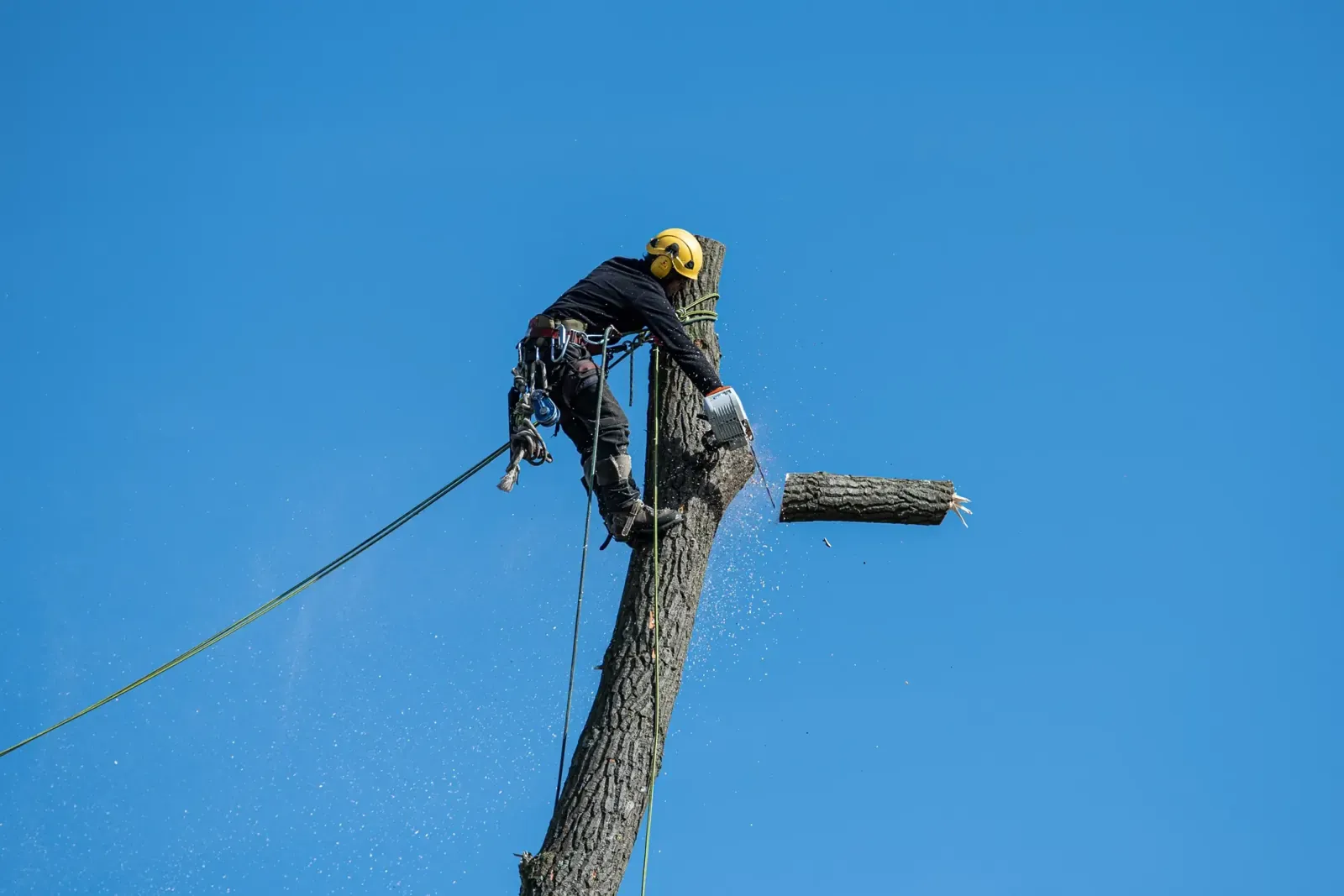
Felling or sectioning. In open ground the tree is notched and felled whole — fast and cheap. Near anything you care about, a climber (or a bucket truck) takes it down from the top in pieces, roping each section to the ground. This is where the 30–60 ft "medium" bracket earns its price.
Crane, when needed. Dead pines and decayed oaks can't be climbed safely because the wood won't hold a rope. Those come down by crane in big pieces, at a premium of roughly $500–$600+.
Chipping and haul-away. Brush goes through the chipper; trunk rounds are hauled or left for firewood. Confirm which you're paying for — a "cut and leave the wood" price is often several hundred dollars less.
Stump. Not included unless the quote says so. Grinding is typically $100–$300 per stump — details here.
What it costs in Redding
The short version: $150–$3,000+, averaging about $700, set mostly by height and by what's inside the fall zone. Emergency and after-hours work runs 2–3× that. The full Redding tree removal cost guide has the size-by-size table, every add-on, and the sourcing behind each number.
| Tree size | Typical Redding cost |
|---|---|
| Small tree (under 30 ft) | $150–$500 |
| Medium tree (30–60 ft) | $500–$1,500 |
| Large tree (60–80 ft) | $1,000–$2,000 |
| Very large (80 ft+), crane, or tight to a structure | $2,000–$3,000+ |
Permits inside Redding city limits
Redding's Tree Management Ordinance (Municipal Code Chapter 18.45) requires a tree removal permit for any tree, regardless of species, over 6 inches in diameter measured 4½ feet up the trunk — unless the property is exempt. The exemption most homeowners fall under is §18.45.040.B.3: a developed residential property already built to the maximum density its zoning allows. In practice, a house on a standard lot that can't be split into more lots is exempt; a two-acre parcel zoned for six homes with one house on it is not, and neither is a vacant lot. Trees on the City's Landmark and Heritage Tree Plan are never exempt, and neither are trees a development approval required to be preserved.
There's also a hazard exemption (§18.45.040.G): a tree that a qualified professional — a Registered Professional Forester or ISA Certified Arborist — has determined to be unhealthy or a danger to life or property can be removed without a permit, as long as that written opinion is made available to the Development Services director before the tree comes down. Removing a protected tree without a permit is punishable by up to $2,000 per tree. The code sets the permit fee by council resolution and does not print an amount; the Planning Division (530-225-4022) can tell you the current figure. Unincorporated Shasta County, Anderson, and Shasta Lake are separate jurisdictions with their own rules. The whole thing, with the section text, is in our permit guide.
How to vet a Redding tree removal company
CSLB C-49 license. California's "Tree and Palm Contractor" classification is required for most paid tree work — anything over $1,000 or needing a permit. Ask for the number and check it at cslb.ca.gov; the record shows whether a bond and workers' comp are on file. Companies that only say "licensed and insured" without a number are asking you to take it on faith.
Insurance certificate, not just the word. General liability covers your house; workers' compensation covers the climber. If a crew without workers' comp gets hurt on your property, the claim can land on your homeowner's policy.
Written, itemized quote. Cutting, hauling, stump, crane, and any permit line each on their own row, so three quotes are actually comparable.
Utility awareness. The estimator should bring up the power line before you do.
Who's doing the work. Ask whether the crew on the day is the company's own or a subcontractor, and whether the sub is licensed too.
Our licensed-and-insured checklist walks through each of these with the exact questions to ask.
A note on Redding's oaks
Blue oaks and valley oaks are the trees Redding's own ordinance was written to protect during development, and they are also the trees that most often need a hard call after a storm. Two things worth knowing: a native oak can look alarming — hollow sections, a dead limb or two — and still be structurally sound for decades, so a "remove it" verdict on a big oak deserves a second opinion from a certified arborist rather than the first estimator through the gate. And an oak that genuinely has to go is a heavy, dense job that will sit at the top of its size bracket ($200–$2,000 nationally across sizes). Trimming is very often the answer instead — see tree trimming and pruning in Redding.
Neighbor trees, in one paragraph
A tree belongs to whoever owns the ground its trunk stands on; a trunk on the line belongs to both owners, and neither can remove it alone. You can trim branches back to your property line at your own expense without hurting the tree, but you can't go onto the neighbor's land to do it, and wrongfully damaging someone else's tree carries 2× to 3× damages under California law. If a neighbor's tree looks hazardous, written notice is what turns "should have known" into "knew" if it later falls. Not legal advice — the neighbor tree law guide has the statutes and the practical steps.
If the cost is the problem
Income-qualified elderly, disabled, or veteran homeowners in unincorporated Shasta County who have failed a county defensible-space inspection can get hazard-tree removal done at no cost through the Western Shasta RCD's Defensible Space Readiness Program. It's real, it's funded, and it's the only such program we could verify — details on the assistance page. For everyone else, the cheapest honest levers are: schedule in the wet season, bundle several trees, keep the wood, and get three quotes.
- Connected with local tree service providers
- Fast removal, trimming & stump grinding quotes
- Shasta County storm-damage response experience
- No obligation to hire
FAQ
Redding Tree Removal — Common Questions
How do I know if a tree needs to be removed or just trimmed?
Remove when the trunk is cracked or split, more than about a third of the canopy is dead, mushrooms or conks are growing from the base or trunk, the tree has developed a new lean, or the roots are heaving. Trim when the structure is sound and the problem is a few dead limbs, roof or line clearance, or shape. When in doubt, an ISA Certified Arborist can assess it on site.
How long does tree removal take in Redding?
A small tree in an open yard takes a crew an hour or two. A medium tree that has to be rigged down in sections is usually a half day. A large oak or pine over a roof, or anything needing a crane, is a full day, sometimes two, plus a separate stump-grinding visit.
Do I need a permit to remove a tree in Redding, CA?
Inside city limits, the City permit under Municipal Code Chapter 18.45 applies to trees over 6 inches in diameter — but a fully built single-family lot is generally exempt, and a hazard tree can be removed with a qualified professional's written opinion delivered to the City first. Vacant land and heritage-plan trees are not exempt. Unincorporated Shasta County is a separate jurisdiction. See the permit guide for details.
Who is responsible if my neighbor's tree falls on my property?
Under California law a tree belongs to whoever owns the land its trunk stands on, and the owner is liable for a fallen tree only if they knew or should have known it was hazardous. A healthy tree that fails in a storm is generally treated as an act of nature, and your own homeowner's insurance is the first call. This is general information, not legal advice — see our neighbor tree law guide.
Can I remove a tree myself to save money?
Legally, an unlicensed person can only do a job under $1,000 total that needs no permit — and practically, felling anything taller than a one-story house without rigging experience is how trees end up on roofs and people end up in the ER. Small ornamentals in open ground are a reasonable DIY; anything over a structure is not.
Are the tree removal companies you connect me with licensed and insured?
California requires a CSLB C-49 Tree and Palm Contractor license for most paid tree work. We recommend verifying any provider's license number yourself using CSLB's free Check a License tool, and asking for a certificate of general liability and workers' compensation insurance before work starts. We don't verify these on a provider's behalf.
Get matched with a local tree service pro
No obligation. We'll connect you with an independent local provider.